About the session
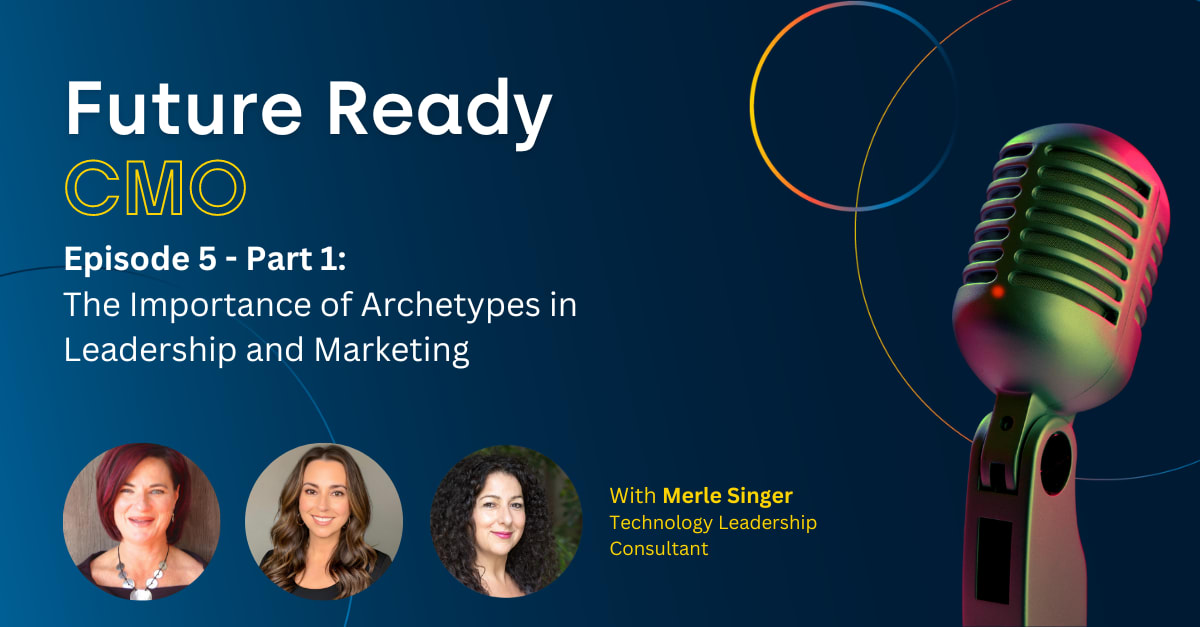
In this episode of the Future Ready CMO podcast, we discuss the importance of archetypes in leadership and marketing with their guest, Merle Singer. They explore how understanding archetypes can help leaders show up authentically and genuinely in their roles, and how this understanding can influence brand narratives and customer relationships.
Listen Now
Key speakers
- Mary Gilbert: Co-host of Future Ready CMO podcast
- Dee Anna Paredes: Co-host of Future Ready CMO podcast
- Merle Singer: Leadership consultant with 25 years of senior leadership roles in the technology sector
Agenda
The conversation revolves around the importance of understanding individual and collective archetypes in leadership and marketing. They discuss how this understanding can help leaders and marketers shape their narratives, show up authentically, and build stronger relationships with their teams and customers.
Takeaways
Takeaway 1: Leadership narratives shifting in a VUCA world
In the Future Ready CMO webinar, Merle Singer shared extensive research on how leadership narratives are changing in a Volatile, Uncertain, Complex, and Ambiguous (VUCA) world. She emphasized that emerging leaders are seeking to reshape traditional leadership models and that the power of archetypes can be leveraged to facilitate this transformation.
Merle Singer explained, "I was really interested in generational leadership shifts...I was really clear about using archetype, at least to start the conversation or frame the conversation." She emphasized the power of the archetypal framework as it "allows you to think about it from a narrative and from a story."
The research indicates that emerging leaders are filled with enthusiasm and creativity, but often find themselves limited by the existing corporate structures. Singer observed, "They come in thinking they're super creative and are kind of told actually you need to have a lot more experience or you need x number of years in the business to do that."
Takeaway 2: Inclusivity and diversity through archetypes
Singer also highlighted that the use of archetypes can promote diversity and inclusivity within leadership roles. She suggested that the archetype model allows leaders to show up genuinely and authentically, embracing their unique leadership styles.
Singer noted, "For me, what was fascinating...was how quickly people take it on and are able to integrate it in the way that they explain their story, which for me tells me it's not a learned thing, it's just a known thing, which is what I think is so incredibly powerful about it."
She further emphasized the importance of having diverse narratives within leadership, stating, "I think there's a question of where are we not focusing our attention? What is slipping through the cracks here because of the way we tend to look at things?"
Takeaway 3: Integrating archetypes into leadership and organizations
Singer also discussed the practical application of archetypes in leadership and organizations. She emphasized the importance of self-awareness in leaders and the consideration of different perspectives to create a well-rounded organization.
When discussing how Dee Anna and Mary could apply their archetypal knowledge in their work, Singer stated, "I think there's a conversation about what are we not seeing? What do we need to see? Are we overplaying something or underplaying something? What are the additional nuances that we can put into our leadership conversations that actually impact our customers, impact our strategy, impact, where we want to go to next, how we are talking about bringing in people into our organization, what does our brand look like?"
Singer concluded with the importance of utilizing archetypal understanding to be the best leaders possible, stating, "I think there are lots of really interesting things to look at ultimately being the best leader you can be so that you are achieving whatever your business focus is."
Insights surfaced
- Archetypes can be a powerful tool for understanding how individuals view and interact with the world, and can influence how leaders show up in their roles.
- Archetypes are flexible and inclusive, allowing for a diverse range of leadership styles.
- Understanding one's archetypes can help build self-confidence and authenticity in leadership.
- Archetypes can help reframe diversity in leadership, moving beyond surface-level diversity to a deeper understanding of diverse narratives and leadership styles.
- Emerging leaders often face stress and anxiety about fitting into pre-existing leadership styles, and understanding their archetypes can help alleviate this.
- There is a need for more representation of emerging leaders in executive teams.
Key quotes
- "I think this gives you a great way to do it. It helps us see our work as part of a story, as part of a universal story." - Merle Singer
- "I think that the ability to know where we are and to have the narratives that actually meet that are really important and there's some there's certainly archetypes that stay with you." - Merle Singer
- "We are a community of marketers on a mission to become leaders of positive change. We're bringing people together to inspire and co-create the strategies and develop the capacity to be leaders." - Mary Gilbert
- "I think there's a conversation about what are we not seeing? What do we need to see? Are we overplaying something or underplaying something? What are the additional nuances that we can put into our leadership conversations that actually impact." - Merle Singer
- "For me, what was fascinating and which really told me how powerful and how deeply seated archetype is in the way we view our world was. I explained to all the people I was interviewing, and I mean, I did 100 in depth interviews across both countries." - Merle Singer
About Merle Singer

Merle has 25 years of senior leadership roles in the technology sector across multi-disciplines. Her experience spans corporate marketing, leadership development, culture & reputation, and a global environmental sustainability. She holds a BA Honors and a Masters in psychology as well as being a graduate of the Australian Institute of company directors. Merle is accredited in Myers Briggs Type Inventory, Hogan Assessment Inventories and Barrett’s Cultural Transformation Tools and is also a qualified yoga instructor.
She runs her own business where her mantra is interrupt the usual which he does by bringing to her work, a unique blend of corporate knowledge and experience combined with passion about people, culture and potential and the stories which color us.
With a deep love of Jungian archetypes, she completed a three-year research project through Deakin University's Business School, exploring how a VUCA world is changing the leadership narratives for seasoned leaders and early career leaders in corporate Australia and the USA. In addition, she was a funded researcher with the Center for Applications of Psychological Type (CAPT) in the update of the Pearson Marr Archetype indicator. Based on the data gathered, Merle has created an Emergent Leadership Program to help emerging leaders flourish.
Connect with Merle on LinkedIn: https://www.linkedin.com/in/mesinger/