About the episode
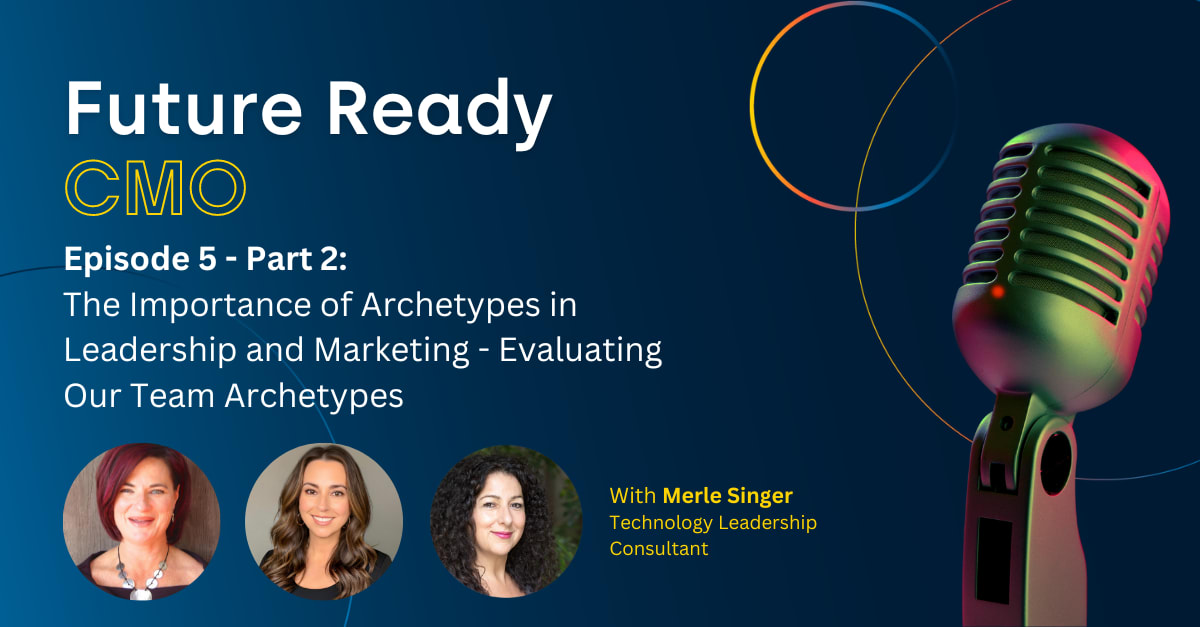
In this episode of the Future Ready CMO podcast, where the hosts Mary Gilbert and Dee Anna Paredes discuss the role of archetypes in leadership and business with their guest, Merle Singer. Merle Singer is a leader in the technology sector with 25 years of experience and a focus on corporate marketing, leadership development, culture, reputation, and global environmental sustainability. The conversation centered around the application of Jungian archetypes in understanding leadership styles and enhancing business performance.
Listen Now
Key speakers
- Dee Anna Paredes, Host of Future Ready CMO podcast
- Mary Gilbert, Host of Future Ready CMO podcast
- Merle Singer, Guest and experienced leader in the technology sector
Agenda
The main focus of the discussion was exploring the use of Jungian archetypes in understanding and improving one's leadership style and business operations. The hosts shared their own experiences and insights on their identified archetypes, and Merle provided her expert analysis and interpretation of these results.
Takeaways
Takeaway 1: Understanding archetypes can provide valuable insights for business partnerships and leadership roles.
In the podcast, Merle Singer, a leadership development expert, introduced the concept of archetypes and how understanding them can provide significant benefits in a business context. She explained that archetypes are flexible and malleable, and understanding them can help individuals identify their strengths and areas for improvement.
“Everything that everybody said is 100% correct. It's also your experience of it. And I think what's really important when we talk around archetype, unlike anything you do in personality, people go with personality. It's like written in stone. There's something kind of like the Sedentary thing. What I love about archetype and what I think is important to talk about as well, it's much more malleable, it's much more flexible, which means you are able to target other ones," Singer said.
She explained that understanding one's archetypes can help in determining where to focus and how to adapt in different situations. “If you think of this as software and being able to access what you need when you need it, which I think is super important," she added.
Takeaway 2: Complementary skills and shared values are key in business partnerships.
Mary Gilbert and Dee Anna Paredes, the hosts of the podcast, discussed their experience as business partners and how understanding their respective archetypes had given them insights into their complementary skills and shared values. They noted that although their archetypes were almost complete opposites, the balance has strengthened their partnership.
"Our idealist values met. And probably a lot of other values were at play," Gilbert shared. "We knew that environment could be created. And then the other thing that was really important to us was to point marketing at things that were actually going to be good for the world," she continued.
Barrettes echoed this, sharing, "Both of us have low warrior. And I'm like, we need to amp up that warrior, man. We need to get that warrior thing cranked up."
Takeaway 3: Personal growth and self-awareness can be achieved through understanding your archetypes.
Throughout the podcast, Singer emphasized how understanding one's archetypes can lead to personal growth and self-awareness. She highlighted that it's important to not only focus on one's strengths but also consider areas for improvement.
“There are ways to do it. But for instance, for me, which I always outsource, the sage, which is such a bad thing to do because there's a lot of sage like stuff that I do bring to an engagement, just maybe not in what I've seen as the stereotyped,” Singer shared.
“None of them are better than the others. And they said, no, but there must be the best leadership one. And I go, there isn't reports and,” she added, emphasizing that there is no "best" archetype and all of them have their unique strengths and potentials.
Gilbert reflected this idea, sharing, "We have been on this learning journey for a few years now and we're constantly working on ways to understand ourselves better and become better leaders."
Insights surfaced
- Understanding and applying Jungian archetypes can help leaders understand their strengths and weaknesses, and how to leverage these for better business performance.
- The hosts' archetypes were almost complete opposites, which they found to be a balance and strength in their partnership.
- The hosts identified a need to strengthen their 'warrior' archetype to improve their business leadership.
- Shared values are crucial in business partnerships, and understanding each other's archetypes can help in aligning these values.
- The conversation highlighted the importance of not outsourcing certain roles based on archetypes, but rather learning to activate those archetypes within oneself.
Key quotes
- "What I love about archetype and what I think is important to talk about as well, it's much more malleable, it's much more flexible, which means you are able to target other ones." - Merle Singer
- "One of the things we both came up with on Friday was like, both of us have low warrior. And I'm like, we need to amp up that warrior, man." - Mary Gilbert
- "I think when we reach into that five to eight, people will experience you quite differently. And that's why I say there's something here about if you think of this as software and being able to access what you need when you need it, which I think is super important." - Merle Singer
- "I think there are two things we should do. I think one is this rather than personality... The second thing is to look at value system and what's important, what's absolutely like the thing that's a make or break." - Merle Singer
- "I think where Dee Anna and I really connected early on was our shared values around companies being accessible to women, to work to mothers in particular, to work in." - Mary Gilbert
- "And then the other thing that was really important to us was to point marketing at things that were actually going to be good for the world." - Mary Gilbert