Report: Marketers and the Global Transformation Toward Good - April 2023
This study of global CMOs taps into the sense of urgency to leverage brands as a force for constructive global change, and highlights the top things these leaders need to move forward with confidence.
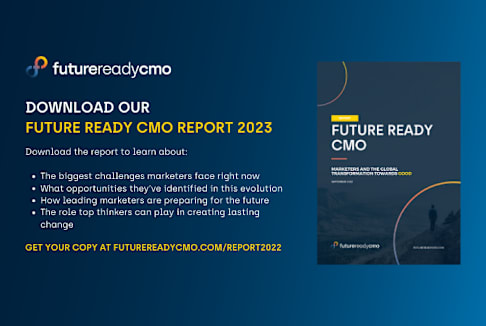
2023
FUTURE-READY CMO
MARKETERS AND THE GLOBAL TRANSFORMATION TOWARD GOOD
RESEARCH REPORT | APRIL 2023
Powered by
THE STUDY
In this study, we dove deep into the minds of
marketing leaders to share their insights,
attitudes, pain points, and outlook for the
future. We also wanted to know how their
goals and aspirations align with the overall
goals of the business.
As marketers ourselves, we’re excited to share
this research with you and the marketing
community. This provides the foundation for
marketing industry leaders to come together,
make connections, and grow.
As social, environmental, and economic shifts accelerate, many organizations are looking to marketers to
lead the change that’s needed — inside and outside the business. But being a force for change isn’t always
easy or intuitive.
We conducted the Future-Ready CMO Research Study in partnership with Intuify to find out how
top-level marketers feel about the role they can play in shaping the future, not just for their company or
clients, but for society as a whole.
2023 Future Ready CMO Research Study 2
Executive Summary As social, environmental, and economic shifts accelerate, many organizations are looking to
marketers to lead the change that’s needed — inside and outside the business. But being a force
for change isn’t always easy or intuitive.
We conducted the Future-Ready CMO Survey Study to find out how top-level marketers feel
about the role they can play in shaping the future, not just for their company or clients, but for
society as a whole.
The new normal is constant change. While marketing leaders wear many different hats, they’re always looking forward and most feel prepared to lead their companies into whatever lies ahead.
Responsibility for positive change on a global scale is shifting onto companies, with eight out of 10 marketing leaders now believing that transforming the world requires a fundamental shift in how we do business.
Most CMOs also believe that marketing is a critical component to bringing about change and feel motivated to lean into this transformation. But they need the right mindset and skills to drive this critical evolution.
Marketing leaders are passionate about making a positive impact both within their organizations and in society at large. However, many face a common barrier in CEOs and stakeholders who need to be convinced of the value.
CMOs see marketing as a crucial component for changing the world. They see the biggest barriers to driving change as: navigating volatility, uncertainty, complexity, and ambiguity (VUCA); empowering their teams; and staying abreast of new technologies and consumer behaviors. Now is the time for marketing leaders to choose to be the change.
2023 Future Ready CMO Research Study 3
Key insights:
Who We Surveyed For this study, we spoke with 58 marketing leaders. Two-thirds (67%) of respondents are chief
experience officers (CMOs) while
one fifth (19%) are partners within
their organizations.
While they’re all dedicated to marketing, a fraction of respondents (16%) oversee other departments at their organization as well, such as operations, technology, employee relations, and more.
Current Position Level
Current Position Level
2023 Future Ready CMO Research Study 4
Respondent Areas of Oversight
96%
1.5% 1.2% 1.2% 1% 1%
67%
19%
9%
14%
10%
`0%
9%
9%
7%
5%
5%
We also connected with organizations of
different sizes, ranging from 1-10 employees up
to 10,000+. The largest percentage (27%) of
respondents work in an organization with
51-200 employees and roughly another quarter
(23%) work in a company with under 50
employees. One third (30%) are in organizations
with 200-1,000 employees and just under one
fifth (16%) work in companies with more than
1,000.
We spoke with professionals across a variety of
industries. Computer software leads the pack
followed by technology and software, financial
services, and professional and business services.
2023 Future Ready CMO Research Study 5
Number of Employees at Organization Industry
Question: What is the size of your organization? (n=42)
14%
10%
28%
17%
14%
9%
4%
5%
Question: What industry do you work in? (n=42)
2023 Future Ready CMO Research Study 6
What Does It Mean to be a Future-Ready CMO?
Nearly all marketing leaders are tasked with thinking about the
future, so what do they think it means to be a “Future-Ready CMO”?
When respondents hear “Future-Ready CMO,” they immediately think of planning. In their eyes, a
future-ready CMO is formulating plans for their organization at least five years out. They understand
new and emerging channels, technological evolution, and how to make the most out of shifting digital
behaviors and trends. If they’re not fully aware of the future, they have the resources to educate
themselves and prepare. A future-ready CMO has an analyst-like, always-learning mindset as well as the
skills to adapt and prepare their team and organization to be technologically, culturally, and socially ready
for the future.
For some CMOs, however, being future-ready implies something that marketing leaders should already
be doing; a CMO is capable of preparing for the future and a new title makes no difference. Others even
believe the CMO role should be split up to reflect the more complex duties of marketing to satisfy all
business challenges.
Every CMO works in the now for the future - brands are a store of future value.
CMO, financial services
2023 Future Ready CMO Research Study 7
What Does the Future-Ready CMO Want?
Our respondents are highly dedicated marketing professionals, each with their own goals and
aspirations. As marketers, respondents said they strive to constantly add value through their work —
such as generating more revenue for the business, educating internal teams, or giving customers a brand
they love.
Many respondents also talked about the benefits they can bring to the companies they work for. This
includes creating responsible brand values, helping their companies grow, and ultimately moving their
organizations forward through marketing. Meanwhile, some are also focused on the teams they lead.
Many CMOs want to be a catalyst for growth, educating their team members and pushing them to be
their best to create a “high performing and impactful team.”
Other marketing leaders want growth for their teams, their organizations, and even society as a whole.
They hope that their work makes a positive impact in all these areas.
To spark change for good, marketing leaders believe their businesses must change the way they work.
When asked whether they agreed or disagreed with the statement, “In order for us to transform the world, we need to transform business”, four out of five marketing professionals agree.
[I want] to be a positive force in the growth and
development of the people on my team. A reason they grow into the careers that
they want to have.
CMO respondent, healthcare
[My greatest marketing desire is] to deliver
world-class products and consumer experiences for
a company.
CMO respondent, healthcare
2023 Future Ready CMO Research Study 8
What Kind of Legacy Does the Future-Ready CMO Want to Leave?
The ambitious marketing leaders in this study feel gratified by what they do and want to leave a legacy
they can be proud of, too. For some, this means simply making a mark, such as improving their business or
the industry as a whole. Others want to make an impact on their customers.
Many marketers are challenged by a lack of resources, which is why some want to be known for defying
the odds and accomplishing great things with what they have.
Innovation is also very important to the marketers we spoke with. Whether that means contributing new
ideas and processes to the industry or implementing new strategies, these leaders want to stand out in an
ever-changing landscape.
[My legacy is ] that I helped as many people as possible become better at what they do while finding work/life balance.
Respondent, Computer Software
Others are more focused on satisfying their clients and helping as many people as possible. This includes
supporting team members in reaching their fullest potential — it’s not just about personal success.
“I want to be viewed as an innovator that wasn't scared to try new things and take chances - and that those tactics resulted in massive success.”
Respondent, Technology
2% 4.7% 4.7% 7%
43% 38%
Question: How much do you agree with the following statement, on a scale of 1 to 6: “In order for us to transform the world, we need to transform business.” (n=42)
“I always want to be seen as doing more with less - punching above my weight class - supporting a mission well beyond making money.”
Respondent, Technology
2023 Future Ready CMO Research Study 9
The CMO’s Role in Business Transformation
When asked about their ability to foster change within their business, the majority of marketers feel
empowered to do so. However, only a fifth (19%) of the audience feels fully vested.
Whether they feel empowered, they do feel responsible. In fact, the majority of respondents feel very or
extremely responsible for leading cultural and business transformation.
Level of Empowerment for Organizational Transformation
Question: How empowered do you feel in your role as a CMO to drive the organizational transformation necessary to lead world-positive change? (n=42)
2.4% 4.7%
12%
38%
26%
19%
Level of Responsibility for Change
Question: On a scale of 1 to 6, how responsible do you feel as a marketer for leading cultural and business transformation? (n=42)
0% 0% 2.4%
12%
47%
38%
2023 Future Ready CMO Research Study 10
Team’s Ability to Lead Change
For the most part, marketing leaders have confidence in their
team’s ability to create change. However, there’s much room for improvement.
To increase confidence among marketing leaders and their teams, about half (49%) feel they need a better understanding of how to shape new narratives in their environment, followed by training on new business and brand engagement models that drive impact.
Confidence of Marketing Team Skill Set
Question: How do you feel about you and your team's current skill set to lead change into the future? (n=42)
0% 0%
21%
45%
26%
7%
Desired Skills and Training for Change
Question: What skills and training do you feel you and your team will need to lead change? (n=42)
44%
49%
39%
32%
29%
7%
2023 Future Ready CMO Research Study 11
Leadership and Future-Ready Efforts
Organizations manage leadership and skills development in many different ways, with nearly half (47%)
of marketing leaders collaborating with HR to establish these types of programs. A third (31%) of
organizations have individual leaders who work with HR to establish these programs, though they set
their own agenda, while a small portion (4%) give sole responsibility to HR.
If given the power to influence future-ready initiatives, organizational culture and team development would be the priority among over a third (38%) of the audience. Meanwhile, one fifth (19%) would choose predictive behavior tools and programs followed by global brand community (12%).
Responsibility of Specifying Leadership and Skills Development Programs
Question: Who is responsible for specifying leadership and skills development programs in your organization? (n=42)
Priority Future-Ready Initiatives
Question: If you could personally influence one future-ready initiative at your organization, what would it be? (n=42)
48%
31%
17%
4%
38%
19%
12%
9.5%
9.5%
9.5%
2%
2023 Future Ready CMO Research Study 12
Top Marketing Pain Points
Marketing leaders have to juggle fulfilling their
primary job functions with preparing their
organization for the future, which can lead to
significant challenges on both the marketing and
transformational sides.
Nearly half (48%) of top-level professionals
struggle with talent development within their
marketing department. Navigating unforeseen
challenges and adapting to new technological
innovations are also common challenges.
Marketing Pain Points
Question: What are your current pain points within marketing? (n=42)
47%
40%
38%
31%
28%
26%
24%
24%
21%
17%
2023 Future Ready CMO Research Study 13
For the most part, our respondents
feel ready to guide their
organizations into the future no
matter what it brings. While they
have the skill set to adapt to any
situation that might arise, they face
many issues on the road to being
ready for anything.
What’s Holding Marketing Leaders Back?
The sense that the main success metric is consumption, which drives the stock market, will mean we will never have world positive change until we get off this quarterly earnings hamster wheel that is creating overt short-termism at best - and falsifying users /ROI/privacy
practices at worst.
Respondent, financial services industry
Finance seems to be a major
constraint for CMOs. While they
may know the best way to prepare,
budget constraints are preventing
them from getting it done. This
includes money to hire new
employees and fill gaps within the
marketing team. Employee skill sets
are also an obstacle for some
respondents.
I feel confident in the future, but the gaps that I deal with lie with skills
gaps within my employees. If they're not up to speed, then it's difficult for me to expect certain behaviors and
results without having to do much of the work myself.
Respondent, technology and software industry
2023 Future Ready CMO Research Study 14
Another perceived gap pertains to the organization itself. Some respondents feel their organization’s
priorities may not align with the future, while others think their organization has a narrow mindset,
which also hinders change.
Time is another key issue, particularly in regard to managing it. CMOs have enough to worry about in the
present, so balancing the work that needs to be done can be a struggle. Others are strategically prepared
but feel pressured to constantly keep up with new technological innovations, such as advances in AI, the
Metaverse, and more.
While CMOs face gaps when preparing their businesses for the future, dealing with them is ultimately
part of the process, according to respondents. Being able to maneuver around such gaps and constantly
learn about new technological advances and trends is what helps an organization prepare.
I work in crypto - that is based on a profound belief that the future
needs to be fairer and more inclusive. The traditional
establishment doesn’t want this change - changing that narrative
and narrow-mindedness is our biggest gap.
Respondent, financial services
Accepting the inevitability of gaps is what makes someone
ready.
Respondent, web industry
2023 Future Ready CMO Research Study 15
Pain Points and World-Positive Change
The majority of companies want to contribute to world-positive change. However, nearly half (48%) of
marketing professionals feel they don’t have time to make the effort because other objectives take
priority. Many also struggle with measuring value to make the case to their CEO or (fellow) C-Suite, as
well focusing primarily on short-term goals.
But it doesn't end there. Another major setback for
CMOs is the decision makers, or other decision
makers, within their organization. Whether it be
the CEO not supporting, empowering, or trusting
the CMO’s propositions, or stakeholders in need of
convincing about the value of enhanced marketing
initiatives, top-level decision makers ultimately
decide what the CMO can and cannot do.
As previously mentioned, some organizations
don’t prioritize future planning, putting things like
short-term profit goals first instead — which can
stand in the way of vital positive change.
“[What holds me back is] convincing other stakeholders
about the business value of enhanced marketing initiatives.”
CMO, construction industry
Empowerment Restraints for Change
Question: What is holding you back from feeling empowered to drive the organizational change necessary to lead your company through world-positive change? (n=42)
48%
43%
31%
26%
26%
12%
7%
2023 Future Ready CMO Research Study 16
Additional Challenges to Driving Change
Respondents feel that short-term goals are largely negative in their organization because they are
ultimately barriers to positive change. Short-term goals create narrow thinking, often driven purely by
revenue rather than looking at the big picture. As a result, this stands in the way of efforts to lead a
company towards world-positive change and may even give rise to unethical business practices.
While a select few CMOs feel empowered to
drive their organizations to make positive
change, they still struggle to align this with
business goals and to explain compelling future
initiatives to stakeholders.
Others feel less empowered because they believe
a complete company mindset and cultural change
is needed at all levels of the organization. There’s
only so much a CMO can do, and these limitations
have left some respondents feeling that pushing
for positive change isn’t even part of their job.
“[What holds me back is] convincing other
stakeholders about the business value of enhanced
marketing initiatives.”
VP respondent, technology and software
The overall company ethos is not consistent with a mindset toward world-positive change.
C-suite respondent, consumer goods industry
2023 Future Ready CMO Research Study 17
Leadership and Future-Ready Efforts
Based on the respondents in this study, seven out of 10 CMOs feel held back by a lack of initiative from
their company’s leadership.
The majority of respondents believe their CEOs and stakeholders feel responsible for the future and
acknowledge that initiatives geared toward this kind of thinking will drive business growth. Despite this,
transformation isn’t happening fast enough according to the majority of marketing leaders, creating a
bottleneck for leading the charge.
Responsibility of CEO for Change
Question: Does your CEO/C-Suite feel that the business has a responsibility to lead world-positive change? (n=42)
Do CEOs agree that world-positive initiatives will lead to long-term revenue?
Question: Does your CEO/C-Suite agree that investing in world-positive initiatives will lead to long-term revenue growth and positive outcomes for the business? (n=42)
Question: On a scale of 1 to 6, how much do you agree with the following statement: “Our culture and business practices are not changing fast enough and will require a much more significant commitment from business leaders to accelerate.” (n=42)
19%
81%
29%
71%
0% 7% 7%
16%
38%
31%
2023 Future Ready CMO Research Study 18
The Future Role of the Marketer
Leadership expectations about the role of marketing changes drastically from marketer to marketer. But
how exactly do marketers think their roles will shift in the near future?
Every marketing professional in this study believes there will be some form of change in their role down the road. And these changes may include new responsibilities spanning outside of general marketing functions, with new roles directly determining a company’s growth and
success, especially when it comes to revenue. In fact, the majority of CMOs (79%) believe they
will have increased responsibility for revenue growth in three to four years. Over half (57%)
believe they’ll be more involved in product definitions and business models as well as bearing
additional responsibility for developing their organization’s internal culture (52%).
Anticipated Role Change in 3 to 4 Years
Question: How do you see your role changing now versus 3-4 years ago? (n=42)
57%
78%
52%
50%
45%
38%
36%
5%
2023 Future Ready CMO Research Study 19
Major Industry Shifts in the Near Future
Marketers expect their roles to significantly change, but what about the rest of their industries? When
respondents were asked to list the major shifts they expect to see within the next one to five years, they
frequently mentioned technology and changes to the ways marketing is conducted.
Emerging Technology Many of these predicted changes have to do with tech. Emerging technology affects
both how businesses function and how consumers behave. As a result, both sides
struggle with addressing wants and needs. Businesses providing the technology may
not know how to demonstrate the benefits of their product because their consumers
may not know exactly what they need or want.
Marketing Technology With the market becoming increasingly crowded, respondents believe that marketing
technology will reach a point of saturation. Others believe AI will lead to
over-automation of the industry, though some respondents also believe that no level
of AI can match actual human expertise.
Along with the increased reliance on technology comes an increased need for
cybersecurity to protect marketing firms and businesses.
Shifts in Marketing When it comes to the marketing industry, respondents have contrasting predictions.
Some believe there will be a shift to predictive marketing and sales, while others feel
that fragmentation of media will increase, leading to unpredictable marketing and an
inability to measure impact. Some believe organizations must continue to find
authentic and relevant ways to reach their consumers, as expectations will continue
to rise. This will only prove to be more difficult, as respondents also see a rise in
competition in the near future.
Major shifts in technology are coming, and how customers want to use/adapt to those technologies can and will create serious challenges in sales management.
Partner respondent, advertising industry
2023 Future Ready CMO Research Study 20
Importance of Impact on Brand Community
Another key shift this audience expects to see in the near future is an added emphasis on doing good in
the world. Respondents feel it’s harder than ever for businesses to foster genuine relationships with their
customers, and marketing leaders acknowledge that organizations must push to focus more on improving
society as a whole, whether through giving back or by adopting more ethical processes.
When presented with the statement, “Businesses
that thrive in the future will do so because they
have had a significant positive impact on social and
environmental issues,” only a handful of
respondents (12%) strongly agreed, while a little
over a third (38%) agreed, and another third (33%)
somewhat agreed.
To make this kind of positive change, organizations
will have to reevaluate both their business models
and overall organizational structures to make sure
they’re geared towards more community-focused
growth.
Companies will have to look at hybrid model of CLG (community led growth), PLG (product led growth) and SLG (enterprise sales) in order to stay ahead of competition. This will take a transformational shift in organization design and culture — people, process, technology, programs, accountability, cross-functional initiatives.
CMO, Construction Industry
Question: On a scale of 1 to 6, how much do you agree with the following statement: “Businesses that thrive in the future will do so because they have had a significant positive impact on social and environmental issues.”
.2%
7% 7%
33%
38%
12%
2023 Future Ready CMO Research Study 21
How are Marketers Preparing for the Future?
To adapt to these anticipated changes, marketers are training themselves and their teams to be experts in
innovation and transformation so they can help the business hone its strategy. When it comes to the
future, some marketers are focused on their teams as they’re the ones who will actively determine the
company’s path. Others are also focused on building agile and curious teams so they can be prepared for
any future need.
Some organizations are planning to be more transparent about their work and what they can accomplish,
both internally and externally. Meanwhile, others are looking for new ways to transform their offerings.
Education is also crucial to preparation, with marketers needing to stay on top of emerging trends.
But the most important part of preparation, according to respondents, is long-term planning.
We are at the precipice of the
industry, so a lot is going to change.
We want to be the category
leaders, so we are spending time
building the brand long-term.
VP respondent, software
Despite uncertainty as well as expected changes in
the industry, marketers have a skill set that equips
them to handle any challenge that comes their
way. Regardless of how marketers plan for future
change, the majority strongly feel that they are prepared.
To further prepare, marketing leaders are
considering participating in a course to help
improve their skills and become a truly
Future-Ready CMO. Should marketing leaders
participate in a Future-Ready CMO course, nearly
half would prefer an all virtual course. The other half would choose a hybrid setting, with a third
preferring a three to four day on-site immersive experience.
2023 Future Ready CMO Research Study 22
Conclusion
The marketing industry is one of the most
explosive business horizontals today, and
marketing leaders feel they must be prepared
for the future. While some are already working
on that preparation, nearly all know they must
actively work to solve internal bottlenecks and
unforeseen external factors in the future. They
also know they need to communicate value to
the CEO and other stakeholders.
Marketing leaders and their teams must take
steps to shape better narratives in an ever
changing landscape, while also re-evaluating
their individual business models to make a more
meaningful impact on the world.
Future marketing leaders must learn how to
clearly communicate their strategies to both the C-Suite and stakeholders. Juggling
future-focused initiatives with short-term business goals will remain a key challenge.
With continued technological and behavioral shifts, marketers are under pressure to educate
themselves and their teams while balancing the short-term and long-term outlook. Marketers
need support in order to grow the skills, connections, and learning needed to succeed in
changing business for the better—of both the planet and humanity.
Level of Preparedness Among Marketers
Question: Question: How prepared do you feel to define and lead the future of business in your role as CMO? On a scale of 1 to 6. (n=42)
2.3% 0% 7%
16%
43%
31%
2023 Future Ready CMO Research Study 23
About Future Ready CMO Future Ready CMO is a community committed to helping marketers become a force for constructive
global change. Both a community and series of programs led by a global cohort of top marketers, cultural
transformation specialists, and leadership trainers, Future Ready CMO is focused on helping marketing
leaders usher in a new dynamic where good businesses thrive. The community is here to build the
emotional strength, strategic capacity, and operational techniques needed to handle what’s to come —
and become the change.
futurereadycmo.com linkedin.com/company/future-ready-cmo
2023 Future Ready CMO Research Study 24
About Intuify Intuify is a leading provider of innovative market research and consumer insights, helping large
and small companies understand and connect with their target audience through cutting-edge
survey methodologies. The company uses a range of state-of-the-art research methods to
provide deeper and more accurate insights into consumer behavior and market trends, enabling
businesses to make more informed decisions and drive growth.
intuify.com linkedin.com/company/intuifyinc/